As a zookeeper in upstate-New York, one of the most common questions I get asked is, "do you get many visitors in the winter?" The Binghamton Zoo is actually closed all winter for two reasons: the hill the zoo is built on is icy and treacherous, and many of the animals are not visible to the public in the winter. After saying this, the response I get (without fail) is, "it must be so nice to have the whole winter off!"
August the arctic fox. He is almost smiling! (Photo courtesy of the Binghamton Zoo)
What? No. The visitors aren't at the zoo, but the animals still are! Many of the animals can handle the frigid Binghamton winters, like the Amur tigers and leopard, the arctic fox, river otters, and the snowy owls. These animals are outside all winter long and are actually much happier than they are in the summer.
Ronde, the African penguin, enjoys enrichment in the snow before he waddles hurriedly back inside
The warm-weather animals get pampered, like the Andean bears, the lemurs, the wallabies, and the African black-footed penguins. Yes, you read that right. Not all penguins like the snow and ice. Animals like these remain indoors most of the winter in heated buildings, so they are not visible to the public. Some of these animals even get additional heat lamps and big beds of hay to keep them extra warm. On warm(er) winter days, we will let the Andean bears or African penguins venture outside for a couple hours, but most of the time, they see the snow and high-tail it back inside.
One of the Amur "kitties" enjoys the snow! (Photo courtesy of the Binghamton Zoo)
During the winter, my job doesn't change. I still clean up after the animals, prep diets, help with vet rounds, maintain exhibits, and design enrichment. Year-round, I am a baby-sitter, doctor, mediator, psychologist, chef, and janitor for all the animals in the zoo. I just shovel a lot more snow in the winter.
Zhin-Li frolics around his exhibit with his mother Mei-Li on a rainy day.
Zhin is the slightly smaller panda with the lighter tail tip...at one point in the video,
he comes to check out my shoe then gets scared and runs away!
Zhin-Li, Binghamton Zoo's baby red panda, is leaving the zoo this winter. Zhin-Li is now six months old and fully weaned; he eats a separate diet of leaf-eater biscuits, bamboo, and apples, just like his mom, and he easily motors all around his exhibit. He still prefers to hang out with his mother, Mei-Li, but is spending more and more time exploring on his own. We are still not planning to introduce him to Xiao-Li, his father, because male red pandas rarely interact with their young in the wild.
Red pandas in the wild are typically solitary, and fully weaned around six months of age, but the cubs tend to stay with the mother until the following summer when more cubs are born. However, the Binghamton Zoo does not have enough room to house an adolescent Zhin-Li, adults Mei-Li and Xiao-Li, and more cubs. Sending Zhin-Li to another zoo allows us to reintroduce Mei and Xiao and hopefully breed them again this spring.
Red pandas are part of a green species survival program (SSP) through AZA-accredited zoos. This means that the captive red panda population is sustainable over time and has a total size greater than 50 individuals. Additionally, the population has a growth rate that is able to maintain 90% of its genetic diversity for over 100 years. As a result, it is important that we breed Mei-Li and Xiao-Li at least one more time to increase their representation in the captive red panda gene pool. And when Zhin-Li is old enough (anywhere between 18 months and three years), he will be bred to a female to propagate his own genes in the population.
So for the time being, our stuffed animal-sized baby will move to the Erie Zoo in Pennsylvania to start a new adventure as an adult panda. Good luck, Zhin-Li!
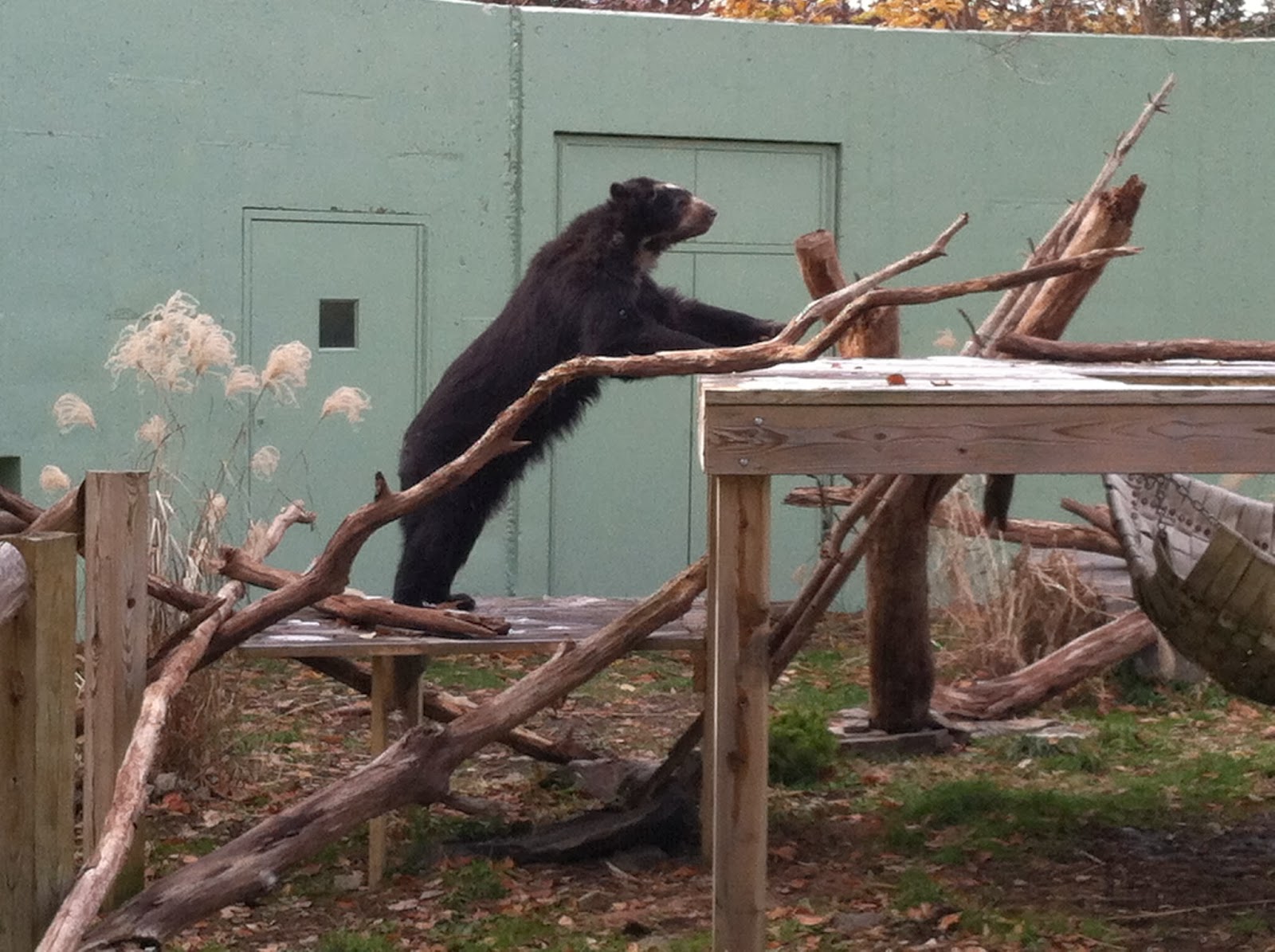
This week, the Binghamton Zoo proudly unveiled its newest animal: an Andean bear named Bernard. Bernard is 22 years old and originally comes from the Buffalo Zoo. He was transferred to the Binghamton Zoo as a companion for our 24 year-old Andean bear, Chica. Bernard weighs 258 pounds and Chica weighs 180 pounds. Andean bears generally live into their late twenties or early thirties in captivity; because these bears are on the older side, they probably will not breed. So we are hoping that Bernard and Chica will keep each other company.
Andean bears, also called spectacled bears, typically live in high-alititude cloud forests in the Andes Mountains in South America. They are the only South American bear and are actually one of the smallest species of bear. These bears are typically very shy and are hardly ever seen in the wild. Andean bears get the nickname "spectacled bears" because of the tan and black markings around their eyes that resemble glasses. These markings are like a human's fingerprints: each bear's markings are unique.
Bernard continuing to explore
Like many people, Andean bears are omnivores, but choose to be vegetarians: they eat fruit, berries, orchids, and bromeliads (like pineapple). Their jaws are so strong that they actually eat the spiky leaves on top of the pineapple as well as the delicious fruit that we eat. These bears are light-weight and have long, curved claws, so they are excellent climbers. They will actually make a nest of broken branches high up in a tree of ripe fruit and not leave until they have eaten all the fruit in the tree. In a pinch, these bears will also eat rodents, birds, insects, and small cows. At the zoo, we feed the bears blueberries, pears, apples, bananas, cooked yams and carrots, grapes, and biscuits specially made for omnivores.
Because these bears are so reclusive, it is hard to gauge how many are left in the wild. Most biologists estimate that there are fewer than 3,000 left in the wild, which classifies them as "vulnerable to extinction." These bears only have 1-2 cubs each year, and only during years when fruit is plentiful, so they do not repopulate quickly. Andean bears are in such a precarious position due to habitat destruction and poaching. Logging companies and expanding towns destroy their forest habitats, and poachers kill them to sell their body parts. Farmers even kill them as agricultural pests because these bears eat crops and livestock.
As a result, Andean bears are part of a monitored breeding program in zoos across the country to preserve genetic diversity and hopefully breed bears to release into the wild. These bears are very difficult to breed in captivity and are called "soul-mate bears" because they will only breed with the "perfect" bear. In fact, only one spectacled bear in the U.S. has given birth to cubs in the last six years. Billie Jean, at the National Zoo, gave birth to two cubs in 2010 and two more cubs this year. Before that, Billie Jean herself is the last surviving Andean bear born in the U.S. Even though the Binghamton Zoo is not planning to breed Chica and Bernard, housing both of these bears gives others zoos room to breed younger bears.
We can't just throw Chica and Bernard together and hope for the best. I am one of two keepers working on introducing the bears. Right now, they have separate indoor dens and get separate time outside in the exhibit. If Chica is out in the exhibit, we will let Bernard into her den to sniff around and play with her toys. This way, the bears get used to each others' scents. Eventually, we will let the bears see each other through a "howdy door." This big mesh door is pinned in place between dens and will let the bears see, smell, hear, and touch each other, but will not let them actually be together. If all goes well, we will then put the bears together. Generally, elderly Andean bears are not put together in zoos, so we are doing this as part of a behavioral study that may set a precedent for other zoos.
Stay tuned to see how Bernard and Chica get along!
No, this isn't going to be a "soapbox speech" about racial or gender judgments. This blog is actually about stereotypic animal behavior. What in the world is that, you ask? Stereotypies are repetitive, ritualistic, often invariant behaviors that appear to have no function. Humans with autism, schizoprenia, and other disorders can exhibit stereotypies, such as body rocking or marching in place. Animals, especially captive animals, also demonstrate stereotypies, including pacing, rocking, swimming in circles, excessive sleeping, self-mutilation, and mouthing cage bars.
A video from Born Free Foundation's archives displays
multiple animals' over-grooming stereotypies
The cause, development, and significance of animal stereotypies are not yet well understood. However, there is a large amount of evidence to suggest that stereotypies result from stress or deprivation in an animal's life, and the stereotypy is that animal's way of coping. Stereotypies are often caused by artificial environments (like a zoo or stable) that do not allow an animal to experience its full range of normal behaviors. Normal animal behaviors are typically governed by negative feedback loops. For example, if a zebra is hungry, it will begin foraging for food. If the zebra eats, this alters the internal cues and reduces the zebra's motivation to forage. A scientist named Odberg said in 1978, that "there is one common factor to all conditions in which stereotypies develop: frustration. In all situations some tendency is being thwarted, some goal cannot be reached, some homeostasis is disrupted." As a result, stereotypies often indicate poor animal welfare.
In other words, some highly motivated behaviors (consummatory behaviors), like mating, may be impossible for solitary animals, regardless of how much "mate-search" behavior (appetitive behavior) is performed. No matter how many times a solitary, captive male okapi raises his hoof in a courtship display, he will never find a female okapi to mate with. Or sometimes the consummatory behavior, like feeding, may be performed without the appetitive behavior. For example, if a captive zebra is fed in a trough, it doesn't have to utilize any foraging and grazing behaviors, so those behaviors are vented in frustration-related stress as stereotypies without a function.
But why are these behaviors so persistent, even if they harm the animal? Why are the behaviors so unvarying? For example, pacing animals often place their feet in exactly the same spot and turn at exactly the same moment on each pass. Well, the answer is a complicated neurobiological lesson. External stimuli (like temperature) combine with internal stimuli (like hormone levels) and memory, which are processed by the brain's "executive systems" to select learned and instinctual behaviors. Stereotypies can be adaptive if they serve as a coping mechanism, maladaptive if they are normally adaptive responses occurring inappropriately in an abnormal environment, or pathological if they are caused by a nervous system dysfunction. Coping is any behavioral attempt to control a situation, whether successful or unsuccessful. Coping is often a learned response: the effects of performing a behavior often reinforce that behavior, leading to stereotypies. So stereotypies often reinforce themselves by changing chemical pathways in the brain.
Bamboo the Asian elephant carries a boat bumper at
Woodland Park Zoo in Seattle, WA.
Photo courtesy of Pattie Beaven, elephant keeper,
at Woodland Park Zoo.
Environmental enrichment can be a way to mitigate captive animal stereotypies. Larger and more stimulating enclosures allow for more movement and foraging, while object, scent, or food enrichment allows animals to experience new stimuli on a daily basis as they would in the wild. If an animal is investigating a new object or playing with enrichment, it will be too busy to stereotype. For example, about 40% of elephants in zoos display stereotypies, like rocking and weaving. If a captive elephant is presented with a tire or boat bumper that it can toss, stomp, and carry, that elephant has an outlet for natural behaviors, and spends less time stereotyping. Housing social animals with other animals of their species or in a mixed-species exhibit can also be beneficial. For example, housing primates together encourages grooming, mating, courtship, fighting, and playing, and discourages frustration-based stereotypies like rocking.
Snowball (left) and Misty at the Calgary Zoo in 1993
In some extreme cases, medications can be used to eliminate stereotypies. Snowball, a polar bear at the Calgary Zoo, started demonstrating stereotypies when she was 2 years old. Her keepers tried enrichment programs, diet variation, and enclosure redesign, without success. The keepers reasoned that Snowball's stereotypies had become so ingrained, that they actually altered the composition of her brain causing a neurological disorder. Snowball was given experimental doses of Prozac, which eliminated her stereotypies.
Stereotypies are a touchy subject. Entire books have been written on animal stereotyping, and this blog post is just a brief overview. PETA and other animal welfare organizations use stereotypies as justification for shutting down zoos and releasing captive animals. However, zoos have positive conservation and education roles in society. As a zookeeper, stereotypies are not insurmountable barriers to animal captivity, but rather challenging obstacles to providing the animals in my care with fulfilling lives. I approach each day as a keeper thinking, "how can I make my animals' lives better today?"
Harris's hawk on glove at the Vermont Institute of Natural Science
"Raptor" comes from the Latin word "rapere," meaning to snatch or grasp. Raptors, or birds of prey, have three distinct characteristics: forward-facing eyes with binocular vision, a sharp, hooked beak, and strong, grasping talons. Raptors are handled using operant conditioning, a type of learning that increases or decreases the probability of a behavior recurring based on the subsequent consequences. Positive reinforcement is an example of operant conditioning most commonly used with raptors; this same type of training is used when you call your dog and praise him for coming when called. I learned how to handle raptors at the Vermont Institute of Natural Science, an avian rehabilitation facility where we conducted multiple flight-shows each day for public education programs. I also took an avian husbandry, handling, and propogation class at Cornell University, and I continue to handle raptors at the Binghamton Zoo.
In this photo with a rough-legged
hawk, the anklets, jesses, leash,
and glove are visible.
Falconry has existed for over 4,000 years and is the source for most of the handling and husbandry techniques used for raptors today. Falconers use a variety of equipment, but most handlers in zoos and rehabilitation centers use the same standard equipment: anklets and jesses around the bird's ankles, a glove to protect the handler, and a leash that secures the jesses to the glove. Flighted birds also wear telemetry (radio transmitters). Gloves typically go on the handler's left arm, and the bird stands on the forearm held at a right angle from the body. The handler's gloved hand makes a loose fist with the thumb on top. The jesses (leather straps) have small slits cut into the ends, which are clipped to the leash. The jesses and leash are then wrapped around the gloved ring and pinkie fingers of the left hand, and the remaining leash is clipped to a ring on the glove or tied with a falconers' knot. Handlers holding a bird always have the right of way. People should pass on the right side (the arm without a bird) and should stay 2-3 feet away from the bird.
With a red-tailed hawk
One of the main problems when handling a raptor is bating. Bating is a bird's attempt to fly from a glove or perch to which it is tethered. It's never pretty. During the bate, the handler is responsible for keeping the bird from hitting anything with its wings or feet and preventing injury to the bird or other people. Birds can often get back on the glove by themselves, but sometimes the handler has to put her ungloved hand on the bird's back and reposition the bird on the glove. The handler should then move the bird away from whatever loud noise, frightening object, or stressful situation caused the bird to bate. Birds can also easily become too hot if they are on a glove and unable to seek shelter. Handlers should watch out for panting or droopy wings. Another danger of handling raptors is being 'footed' or bitten. A frightened or aggressive raptor will strike out with its talons or beak to defend itself, so the handler should be confident and competent to prevent injury.
Flying HaHa, the Harris's hawk, to
catch a fake rabbit lure
Handlers must build a relationship with a bird (or any animal) in order to train it. A Harris's hawk (HaHa) at the Vermont Institute of Natural Science definitely put me to the test. Harris's hawks are actually highly social raptors (an unusual characteristic), and they hunt in packs like wolves. Because HaHa was the only Harris's hawk at the Vermont Institute of Natural Science, the handlers were his pack. Naturally, HaHa wanted to be alpha bird over any new handlers, so he made me 'run the gauntlet' to assert my dominance and become a new handler. I was bitten and footed more times than I can count, but I sucked it up and kept working with him. Finally, I gained his respect and he began training for me. And I knew I was part of the pack when a new handler started and HaHa began picking on her instead!
With a snowy owl
Raptors take time and motivation (food!) to become acclimatized and desensitized to standing on glove. Generally, a glove is first placed over a perch in the bird's enclosure, and the bird's food is placed on the glove, so the bird begins to associate the glove with positive experiences. Then a handler is present in the enclosure while the bird is eating. Eventually the handler wears the glove and holds it in the same place as the stationary glove perch. The handler slowly begins to move around the enclosure with the bird standing on the glove. For flight programs, two handlers wear gloves and the bird first has to step between gloves. Then the handlers slowly get farther away from each other so the bird has to make short flights between them. Every time the bird does something correctly, it receives a food reward. Every time the handler tries something new and the bird responds correctly, it receives a jackpot (a much bigger reward). I won't go into nitty-gritty details about training in this blog, but be on the lookout for a detailed blog on operant conditioning coming soon!
Working with raptors has been an incredibly enjoyable and challenging experience for me. They are such intelligent animals, and I think they have trained me more than I have trained them.
Zhin-Li is now exploring his outdoor exhibit and becoming more independent. He is still trying to nurse in addition to eating solid foods, but Mei-Li keeps batting him away and leaving him alone for longer and longer periods of time. In the wild, this cub would already know how to fend for himself! He is still a little unsteady on the propping in his exhibit, but he is figuring out how to climb slowly but surely. Except for the occasional mishap!
PUMPKINS!
Binghamton Zoo's tigers, Terney and Koosaka, celebrated Halloween early this year. On Monday, the keepers gave them each a forty-pound pumpkin. The tigers rolled on them, bit them, scratched them, and kicked them. They chased each other around the yard and stole each other's pumpkins. Terney even dumped hers in the pool! Then Terney decided she wanted the pumpkin out of the pool, so she sunk her teeth in, and effortlessly pulled it out. A forty-pound pumpkin. That took two keepers to carry. This just reinforces why we don't go in the exhibit with these girls!
There aren't many toys that can withstand being batted around by a tiger. No wonder Terney and Koosaka love pumpkins so much!